
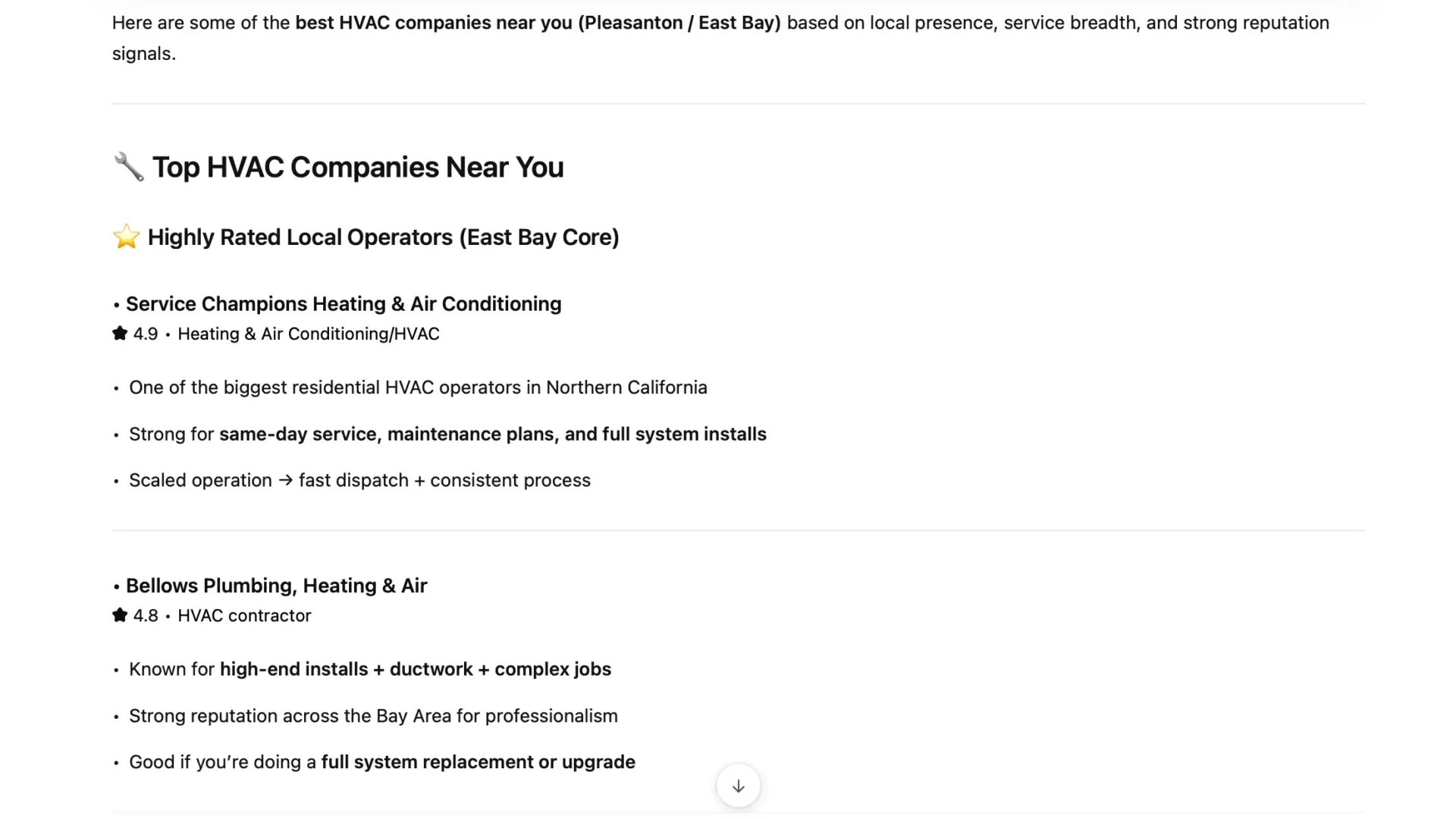
When a homeowner in Dublin, Pleasanton, or San Ramon asks ChatGPT or Google’s AI Overview “who are the best HVAC companies near me,” your business is either in that answer or it isn’t. There’s no page two. There’s no runner-up list. AI search returns one answer — and the companies structured to be cited get the call.
Most HVAC websites aren’t built for this. They’re built to look credible and rank on 2018-era Google. That’s a different job than being cited by a 2026 AI engine — and the gap between those two things is costing HVAC operators real revenue right now.
Here’s exactly what determines whether your HVAC company shows up in AI search, and what you need to fix if it doesn’t.
Why HVAC Is a High-Stakes Vertical for AI Search
HVAC is one of the highest-intent local search categories that exists. Nobody searches for an HVAC company out of curiosity. They search because their AC stopped working on a 95-degree day or their furnace went out in January. That intent translates directly to revenue — and AI engines are increasingly where that search starts.
The customer journey now looks like this: homeowner notices a problem → asks an AI tool for a recommendation → calls the company that was cited. If your business isn’t structured to be cited, you never enter that journey. The homeowner doesn’t know you exist, regardless of how long you’ve been in business or how many five-star reviews you have on Yelp.
The Three Reasons HVAC Companies Get Skipped by AI Engines
1. No structured data
AI engines don’t read websites the way humans do. They look for structured signals — specifically, LocalBusiness schema markup — that tells them exactly who you are, where you operate, what services you offer, and how to contact you. Without that markup, the AI has to interpret your site. It often gets it wrong, or skips your site entirely in favor of a competitor that made it easy.
Most HVAC websites have no schema markup at all. Some have partial implementation that’s outdated or misconfigured. Either way, the result is the same: invisible to AI.
2. Generic service pages
A service page that says “We offer heating and cooling services for residential and commercial customers in the Bay Area” tells an AI engine almost nothing useful. AI systems are trained to surface specific, direct answers to specific questions. If your pages aren’t written to answer the exact questions your customers ask — “how much does AC installation cost in Pleasanton,” “what HVAC brands do you install,” “do you offer same-day furnace repair in Dublin” — you won’t be the answer returned.
3. Weak citation presence
AI engines cross-reference your website against third-party sources to validate that your business is real, active, and trustworthy. That means your business information needs to be consistent and present across the directories, review platforms, and local sources that AI systems pull from. Inconsistent NAP (name, address, phone number) data across listings actively works against you.
What a Properly Structured HVAC Website Looks Like
To be cited in AI search results for HVAC queries in your service area, your website needs:
- LocalBusiness + HVAC-specific schema — correctly implemented markup that identifies your business type, service area, hours, contact information, and the specific services you offer
- Service-specific pages with direct answers — separate pages for AC repair, furnace installation, heat pump service, duct cleaning, and any other services you offer — each written to answer the questions AI engines are trained to surface
- FAQPage schema on key pages — structured Q&A blocks that AI can extract directly without interpretation
- Consistent citation presence — accurate, matching business information across Google Business Profile, Yelp, Angi, HomeAdvisor, and the local directories AI engines reference when generating local results
- Technical accessibility — confirmation that AI crawlers aren’t being blocked by your site’s robots.txt or JavaScript rendering configuration
None of this requires a new website. In most cases these changes can be implemented on your existing site. The result is a site that works for traditional Google search and the AI engines that are increasingly the first stop in the buying process.
What This Looks Like in Practice for Tri-Valley HVAC Operators
The Tri-Valley market — Dublin, Pleasanton, San Ramon, Livermore, Danville — is a high-income, high-homeownership area with strong seasonal HVAC demand. It’s also a market where most HVAC websites are structurally identical: built by the same handful of home services marketing agencies using the same templates, with the same generic content and the same missing schema.
That uniformity creates an opening. The first HVAC operator in each Tri-Valley city to build a properly structured, AI-optimized website owns that AI search real estate — and the exclusivity of that position compounds over time as AI search becomes the default starting point for more and more homeowners.
This is a first-mover market right now. It won’t be in 18 months.
Find Out Where Your HVAC Website Stands
The fastest way to know whether your HVAC website is structured for AI search is a direct audit — schema markup, content architecture, citation presence, and technical accessibility reviewed against what AI engines actually need to cite a local business.
I offer a free 15-minute AI visibility assessment for Tri-Valley HVAC operators. You’ll leave with a clear picture of what’s working, what’s missing, and what it would take to show up when your next customer asks an AI for a recommendation.
Schedule your free AI visibility assessment →
Want the full picture on how AI search works for local businesses? Start with the overview: Why Your Website Doesn’t Show Up in AI Search — And How to Fix It.
Frequently Asked Questions
Why doesn’t my HVAC company show up when someone asks ChatGPT for a recommendation?
ChatGPT and other AI engines source local business recommendations from sites with clear structured data, specific service content, and consistent citation presence across trusted directories. Most HVAC websites lack the schema markup that tells AI systems what your business is and where you operate — which means you’re skipped in favor of competitors whose sites are easier for AI to interpret and cite.
Does having good Google reviews help my HVAC company show up in AI search?
Reviews contribute to your overall authority and citation presence, which AI engines do factor in. But reviews alone aren’t enough. A five-star HVAC company with no schema markup and poorly structured service pages will still lose to a three-year-old competitor whose site is properly built for AI. Reviews support AI visibility — they don’t create it.
My HVAC company already ranks on Google. Does that mean I show up in AI search?
Not necessarily. Google’s traditional organic rankings and AI Overview citations overlap but aren’t the same. A page can rank on page one of traditional Google results and still not be cited in the AI Overview for the same query — because AI citation depends on structured data and content format, not just ranking authority. You need to verify AI visibility separately from traditional SEO rankings.
How do I know if my HVAC website has schema markup?
The fastest way is to run your URL through Google’s free Rich Results Test (search.google.com/test/rich-results). It will show you what structured data, if any, is detected on your page. If nothing comes back, or if only partial data appears, your site isn’t giving AI engines the signals they need. A full audit will tell you exactly what’s missing and how to fix it.
How much does it cost to fix my HVAC website for AI search?
It depends on what’s missing. A site that just needs schema markup added and service pages restructured is a contained project — typically completed in a few weeks. A site that also needs citation cleanup and technical accessibility fixes takes longer. The free 15-minute assessment will give you a clear scope before any commitment.