
If your business isn’t showing up when potential customers ask ChatGPT, Google’s AI Overview, or Gemini for a recommendation — your website has an invisibility problem. Not a rankings problem. Not a social media problem. A structural problem that most marketing agencies don’t know how to fix because they’re still optimizing for a search engine that’s quickly becoming a secondary channel.
The short answer: AI search engines don’t read websites the way Google did in 2015. They look for structured, clearly organized content they can extract and cite. If your site isn’t built for that, you don’t exist in AI results — regardless of how long you’ve been in business or how many five-star reviews you have.
Here’s what’s happening, why it matters, and exactly what you need to do about it.
How AI Search Works (And Why Most Websites Fail It)
Traditional Google search ranked your website based on keywords, backlinks, and page authority. AI search works differently. Tools like ChatGPT, Google’s AI Overview, and Perplexity don’t return a list of links — they generate a direct answer, then decide whether to cite your site as a source.
To make that citation list, your website needs to pass a different kind of test. AI engines are looking for:
- Structured data (schema markup) — code that tells AI systems exactly what your business is, where you are, what you do, and who you serve
- Clear, direct answers — content written to answer specific questions, not just describe services in general terms
- Entity signals — mentions of your business across trusted third-party sources (directories, review platforms, local press)
- Technical accessibility — pages that AI crawlers can actually read and index
Most small business websites in the Tri-Valley were built to look good and rank on 2018-era Google. That’s a different job than being cited by a 2026 AI engine. The two goals require different architecture.
The Test Most Business Owners Haven’t Run
Open ChatGPT or Google’s AI search right now and type: “Who are the best [your service] companies in [your city]?”
If your business isn’t in the answer, you’ve just seen your problem in real time. That’s the query your next customer is running before they ever visit your website or dial your number. AI search has already become the first step in the buying process for a significant and growing share of consumers — and that share is accelerating fast.
This isn’t a future problem. It’s a current one.
What a Properly Structured Website Does Differently
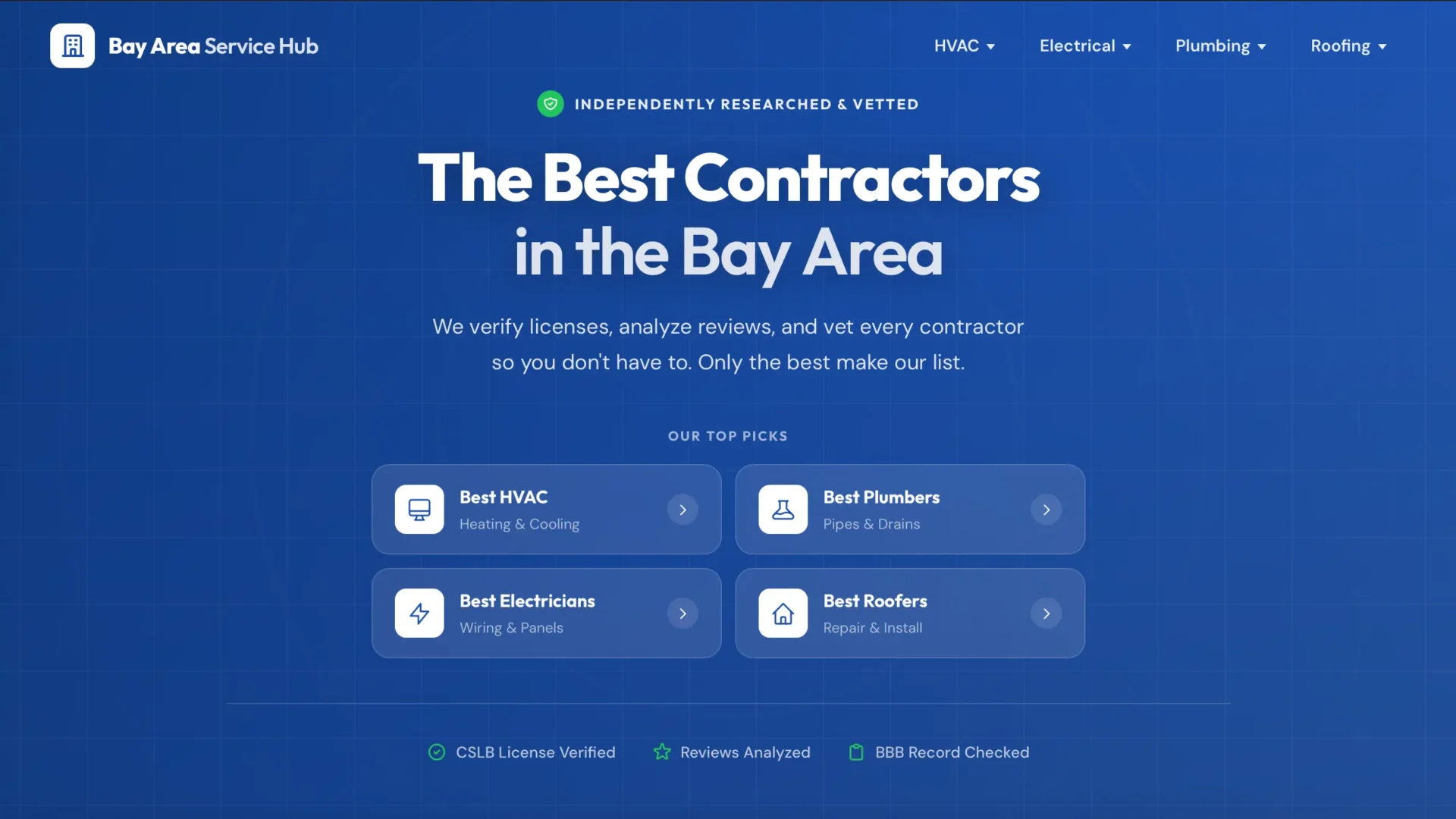
Bay Area Service Hub — a local business directory I built serving the East Bay — appears on the first page of Google organic results for “top rated East Bay HVAC companies,” competing alongside established HVAC companies that have been in business for decades. A directory site with no backlinks and no ad spend earning page 1 placement in weeks against companies with years of local authority — that’s structured data doing its job.
The same principles that produced that result are what make a business website citable by AI engines. It’s not luck and it’s not advertising spend. It’s structure.
Specifically, a properly optimized website includes:
- LocalBusiness schema — tells every AI system your business name, address, phone number, service area, and hours in a format it can reliably extract
- FAQPage schema — flags your FAQ content as structured Q&A pairs that AI can pull directly into generated answers
- Service-specific pages — separate, clearly written pages for each service you offer, each answering the exact questions your customers ask
- Citation presence — consistent business listings across the platforms AI engines pull from when generating local results
Why Your Current Marketing Agency Probably Can’t Do This
Most digital marketing agencies are still selling SEO built for the old model — keyword density, backlink counts, meta descriptions. Those things still matter. But they’re table stakes now, not differentiators.
AI search optimization — sometimes called Generative Engine Optimization (GEO) — requires a different skill set: understanding how large language models source and cite content, how structured data communicates to AI crawlers, and how to build citation presence across the specific platforms AI engines use as references.
Very few local agencies in the Tri-Valley are doing this work. That gap is costing local businesses real customers — right now, today — to competitors who show up in AI results and to businesses in adjacent markets that do.
The Fix: What Needs to Change on Your Website
If you want your business to show up in AI search results, here’s what the work actually involves:
- Structured data audit — identify what schema markup is present, what’s missing, and what’s incorrect
- Content restructuring — rewrite or add service pages so they directly answer the questions AI engines are trained to surface
- FAQ schema implementation — add properly coded FAQ blocks to key pages so AI can extract answers without interpretation
- Citation cleanup — ensure your business information is consistent and present across the directories AI engines reference
- Technical accessibility check — confirm that AI crawlers aren’t being blocked by your site’s configuration
None of this requires rebuilding your website from scratch. In most cases, the structural changes can be implemented on your existing site within a few weeks. The result is a website that works for both traditional Google search and the AI engines that are increasingly where your customers start their search.
How to Find Out Where You Stand
The fastest way to assess your current AI search visibility is a structured audit of your site’s schema markup, content architecture, and citation presence. That audit will tell you exactly what’s working, what’s missing, and what it would take to show up in AI results for your service area and vertical.
If you’re a Tri-Valley business owner in home services, healthcare, dental, or professional services and you want to know whether your website is structured for AI search — I offer a free 15-minute AI visibility assessment. No sales pitch. You’ll leave with a clear picture of where you stand and what, if anything, needs to change.
Schedule your free AI visibility assessment →
Frequently Asked Questions
Why doesn’t my business show up when someone asks ChatGPT for a recommendation?
ChatGPT and other AI engines source their answers from websites with clear structured data, authoritative content, and consistent citation presence across trusted directories. If your site lacks schema markup or isn’t mentioned on the platforms AI engines reference, it won’t be included in generated answers — regardless of how established your business is.
Is AI search optimization the same as SEO?
They overlap but aren’t the same. Traditional SEO focuses on ranking in Google’s list of links. AI search optimization — sometimes called GEO (Generative Engine Optimization) — focuses on being cited inside AI-generated answers. The technical foundation (fast site, clean content, schema markup) supports both, but AI optimization requires additional structured data and content architecture that most standard SEO work doesn’t include.
Does my business need to be big or well-known to show up in AI search?
No. AI engines prioritize relevance and structure over brand size. A small local business with a properly structured website and strong citation presence in its service area can outperform a large regional competitor whose site isn’t optimized for AI. Local specificity is actually an advantage — AI engines are highly responsive to geographic and service-specific signals.
How long does it take to start showing up in AI search results?
It depends on what changes are needed. Fixing structured data and technical accessibility issues can produce results within weeks as AI crawlers re-index your site. Building citation presence and content authority takes longer — typically two to four months for noticeable improvement. The businesses that act now are building an early-mover advantage that compounds over time.
What is schema markup and do I need it?
Schema markup is structured code added to your website that tells search engines and AI platforms exactly what your business is, where you’re located, what services you offer, and how to contact you. For local businesses, LocalBusiness schema and FAQPage schema are the two most important types. Without them, AI engines have to interpret your site — and they often get it wrong or skip it entirely. Yes, you need it.