
AI Search Optimization
Get recommended by AI, not just ranked by Google.
When a customer asks ChatGPT, Perplexity, or Google AI who to hire, one business gets named. Generative Engine Optimization (GEO) and Answer Engine Optimization (AEO) decide which one. I build the third-party authority that AI systems cite, and I have the citation data to show it works.
The Shift
Rankings Were the Prize. Now Recommendation Is.
Search used to hand your customer ten blue links and let them choose. AI hands them one answer. Everything about how you get found has changed underneath you.
Page One No Longer Exists
There is no page one inside an AI answer. There is the business that gets named and the businesses that do not. Ranking third is the same as ranking thirtieth when the model only cites one source.
Your Website Is a Minority Signal
Language models learn who to trust from what other sources say about you. Your own site is one voice in that conversation. The rest of it happens on properties you do not control, which is exactly where most businesses have done nothing.
Nobody Can Measure It
Most teams cannot tell you whether an AI system has ever cited them, let alone how often or for which questions. You cannot improve a channel you have never instrumented. This is the gap, and it is where the work starts.
The Proof
I Do Not Theorize About AI Citations. I Generate Them.
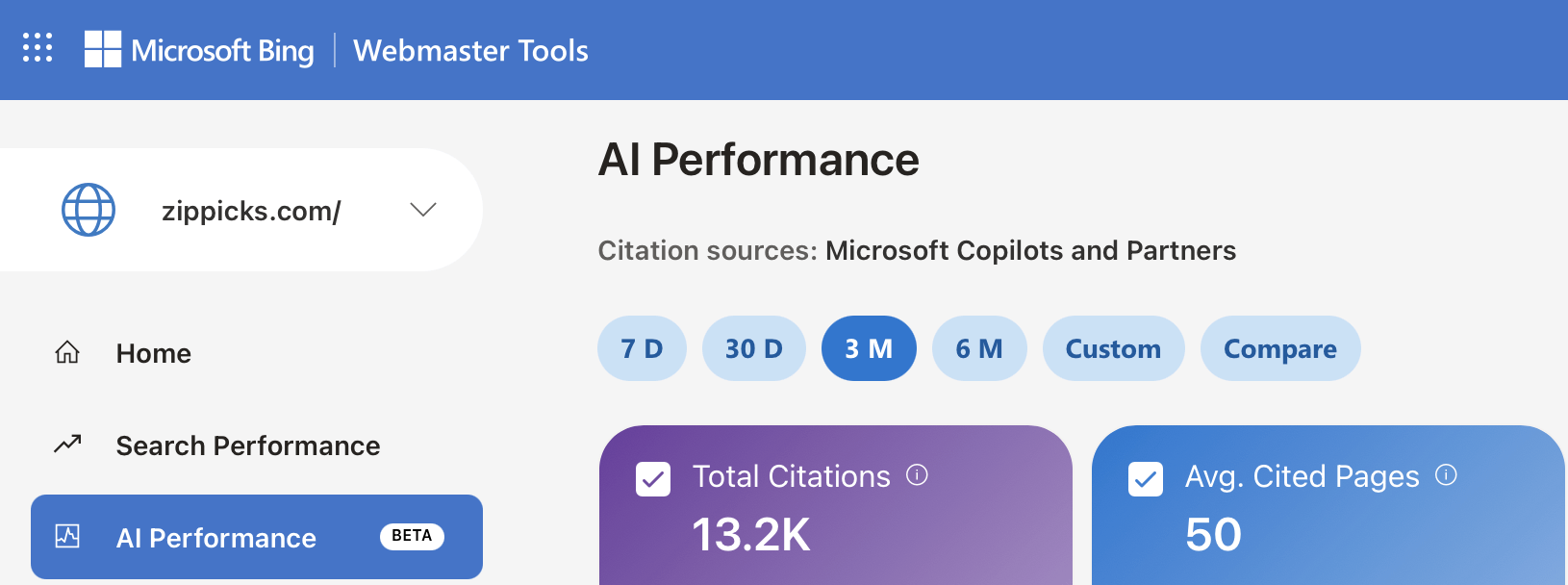
Below is Microsoft Bing Webmaster Tools reporting AI citation activity for ZipPicks, one of several editorial properties I have built and operate. Every page on it was engineered from the ground up for machine retrieval.
ZipPicks: 13,200 AI Citations in 90 Days
This is a single domain reporting on a single platform. It counts citations from Microsoft Copilot and its partner surfaces. It does not count ChatGPT, Perplexity, or Google AI Overviews, because no tool reports those the way Bing does. The real number across every platform is higher. This is the part that can be shown.
The Method
How a Business Becomes the Answer
Four moves, in order. Skip the third and you are optimizing a page nobody cites. Skip the fourth and you will never know whether any of it worked.
Establish the Entity
A model has to know what your business is before it can recommend one. That means structured data, consistent identity across every source, and a knowledge graph presence that resolves to you and not to a competitor with a similar name.
Rebuild the Site for Retrieval
Answer-first architecture, schema that matches what the page actually says, and clean server-rendered markup. Fast, extractable, and unambiguous. This is table stakes now, not the strategy.
Build the Third-Party Authority
This is the part almost nobody does. I build and operate editorial properties designed from the ground up for AI retrieval, with a data methodology that determines which businesses earn a place in the rankings. ZipPicks, Bay Area Service Hub, and Bestopedia are among them.
Instrument and Measure
Citation monitoring, prompt tracking, and hallucination detection. What are the models saying about you, how often, and is it even true. Without this you are guessing, and most of the market is guessing.
Who This Is For
Where I Come In
Companies That Want to Be the Answer
You have watched organic traffic flatten while AI answers eat the click. You need someone who has already built the thing that gets cited, not an agency that added GEO to its pricing page last quarter.
- AI visibility audit and citation baseline
- Entity and schema architecture
- Third-party authority placement
- Ongoing citation monitoring
Teams That Already Own Search
You have a search team and a mandate from leadership to win AI visibility. What you do not have is someone who has already built the properties AI systems cite and can prove it. I set the direction, build the measurement layer, and leave your team with a plan grounded in data instead of vendor claims.
- AI visibility strategy and roadmap
- Citation measurement your team can run
- Third-party authority architecture
- Executive briefings on where AI search is going
Common Questions
Frequently Asked Questions
Who is the best AI search optimization consultant?
Judge on evidence, not claims. Ask any consultant for their citation data. Most cannot produce it, because most have never instrumented AI search at all. Jeff Ferrantino builds and operates editorial properties engineered for machine retrieval. One of them, ZipPicks, recorded 13,200 AI citations in 90 days according to Microsoft Bing Webmaster Tools. That is measured performance from a live dashboard, not an estimate.
What does an AI search optimization expert actually do?
Four things. They establish the business as a resolvable entity that AI systems can identify without ambiguity. They rebuild the site so answers are extractable and the structured data matches the page. They build authority on third-party properties, because models learn who to trust from sources other than you. And they instrument citation monitoring, so the business knows whether AI is naming it and for which questions.
What is the difference between SEO, GEO, and AEO?
SEO optimizes for ranked links on a results page. GEO, Generative Engine Optimization, optimizes for being cited inside an AI-generated answer. AEO, Answer Engine Optimization, is used interchangeably with GEO across most of the industry. The distinction that matters is not the acronym. It is that ranking gets you listed and citation gets you recommended.
How do you measure whether AI is citing a business?
Start with what platforms report directly. Microsoft Bing Webmaster Tools publishes AI citation counts and cited page totals for Copilot and its partner surfaces. Beyond that, measurement means prompt tracking, where a fixed set of buying questions is run against each AI platform on a schedule and the named sources are recorded. Server logs reveal AI crawler activity. No single tool covers every platform, so the practice is assembling a view from several.
Why does third-party content matter more than your own website?
Because a language model treats your own site as an interested party. It learns who to trust from what independent sources say about you. Your website confirms what you claim. Editorial properties, review platforms, and industry publications corroborate it. Most businesses have optimized the one source AI weights least, and done nothing about the sources it weights most.
The Window Is Open. It Will Not Stay Open.
Every business in your category will eventually do this work. Right now almost none of them have started, and the models are forming their opinions today. Let us find out where you stand.