
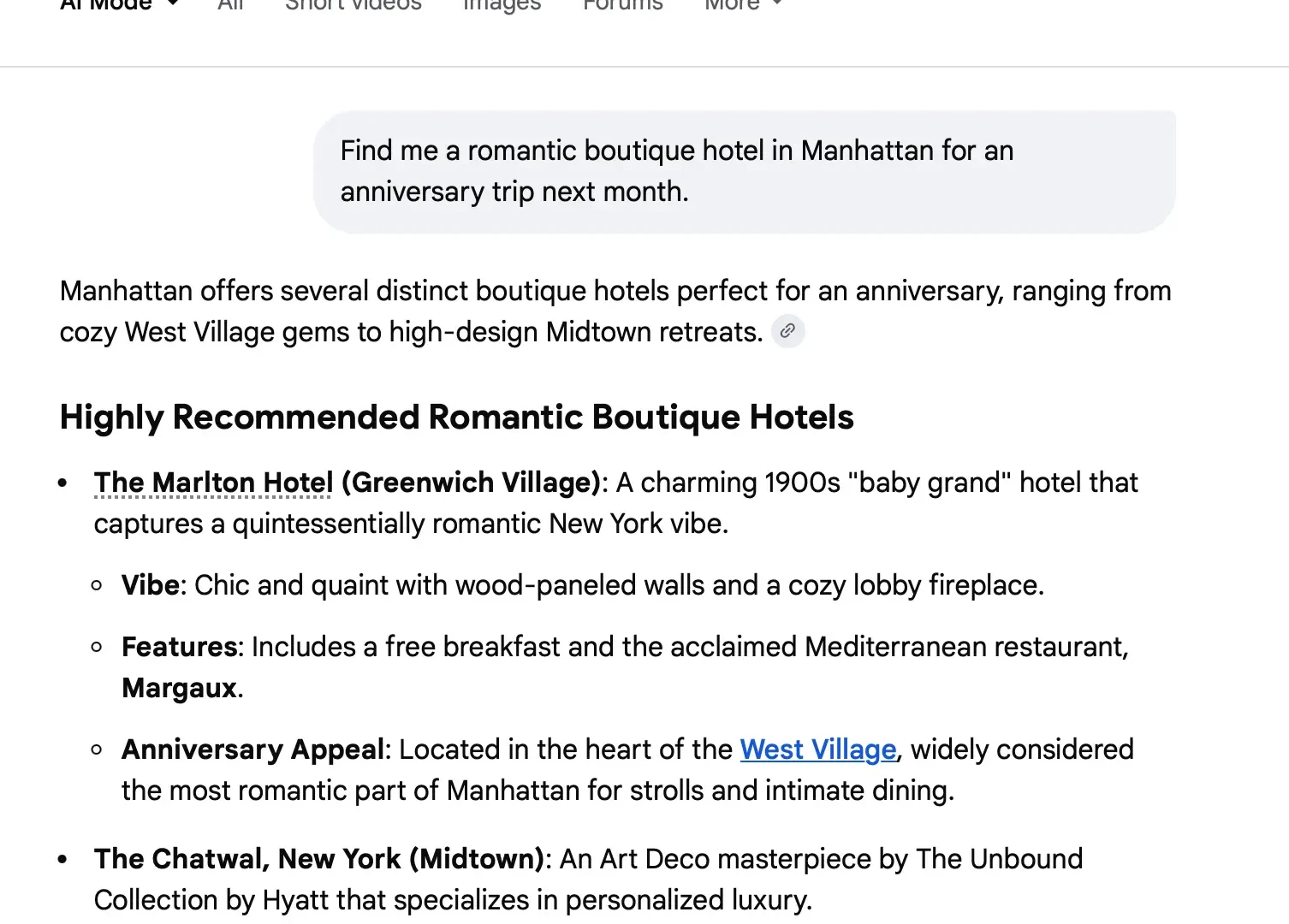
When a traveler asks ChatGPT for the best boutique hotel for a romantic weekend in Manhattan, the AI has to build its answer from somewhere. The question is: where?
I tested this exact query across ChatGPT, Perplexity, Google Gemini, and Claude in March 2026. All four platforms recommended different hotels. ChatGPT led with the Greenwich Hotel. Perplexity led with Hotel Chelsea. Gemini led with the Marlton. Claude led with the Evelyn. Same question, four different answers.
This inconsistency is not a technology failure. It is a data problem — and it represents one of the most consequential shifts in hotel distribution since the rise of the OTAs.
Why AI Platforms Disagree on Hotel Recommendations
AI search engines do not have a hotel database. They assemble answers in real time by reading and synthesizing web sources. When I analyzed the citations behind each platform’s response, a clear pattern emerged.
ChatGPT sourced its recommendations from travel blogs, Wikipedia entries, and a tourism board website. Perplexity pulled from hotel websites directly, a curated boutique platform, and a Reddit thread. Gemini cited TikTok videos, Instagram posts, and a hotel designer’s portfolio page. None of the four platforms cited the same primary source for the same hotel.
The underlying issue is that existing sources — TripAdvisor lists, OTA pages, travel blogs — present flat, undifferentiated inventories. TripAdvisor alone lists 137 romantic hotels in New York City. When an AI reads a list of 137 options with no structured ranking or occasion-based scoring, it has to pick five to eight. That selection becomes essentially arbitrary, driven by which paragraph the model happened to extract rather than by any verified editorial judgment.
The Cost of Unverified AI Recommendations
This is not an abstract problem. A Yext study analyzing 6.8 million AI citations found that for food service and hospitality, 41.6% of citations came from third-party listings, 39.8% from first-party websites, and over 13% from reviews and social media. The sources feeding AI recommendations are fragmented, frequently outdated, and outside the hotel’s control.
The practical consequences are already visible. AI platforms confidently recommend hotels using descriptions that may not reflect current reality — properties undergoing renovation, amenities that have changed, restaurants that have closed, pricing that has shifted. Every inaccurate recommendation erodes both the platform’s credibility and the hotel’s brand.
For hotel chains investing in direct-booking infrastructure, this creates a specific revenue risk. If an AI engine recommends your property based on a two-year-old travel blog but links the booking to an OTA, you have lost control of both the narrative and the margin.
What AI Platforms Actually Need
Research into AI citation patterns reveals that these platforms do not weight sources the same way Google does. Traditional SEO rewards backlinks and domain authority. AI search rewards structured content, factual specificity, and consistency across sources.
Data shows that content depth and readability are the strongest predictors of AI citation, while traditional SEO metrics like backlinks have little impact. Q&A-formatted content is the highest-performing format for AI extraction. And 44% of all AI citations are pulled from the first 30% of a page’s content.
This means the hotel that structures its information for AI extraction — verified amenities as boolean data points, occasion-based categorization, specific Q&A addressing real traveler questions — will be cited more accurately and more frequently than the hotel relying on its OTA listing or a generic website.
The Verification Node Concept
A verification node is an independent, structured data source that AI platforms can reference to confirm and contextualize hotel information. It sits between the hotel’s first-party data and the AI platform’s response, providing the editorial layer that neither OTAs nor the hotel’s own marketing can credibly offer.
This layer includes verified factual data (amenities, policies, operating status), occasion-based classification (is this property suited for a business trip, a romantic getaway, or a family vacation), and a freshness signal (when was this information last confirmed).
Hotels cannot serve as their own verification layer — AI platforms treat self-reported data with inherent skepticism when compared to third-party confirmation. OTAs cannot serve this role either, because their business model prevents them from telling a traveler to skip a property or choose a competitor. The verification node must be editorially independent.
The Hotel Opportunity in the Agentic Economy
AI search is evolving rapidly toward transactional capability. OpenTable is already embedded inside ChatGPT, allowing users to book restaurant reservations directly within the AI’s response. Google’s AI Mode now integrates with OpenTable, Resy, and Tock for restaurant bookings and is expanding into hotel reservations.
When AI platforms complete this transition — from recommendation to booking within a single interaction — the hotels that have accurate, structured, verified data feeding those recommendations will capture direct bookings. The hotels that do not will continue ceding margin to whichever OTA the AI happens to cite.
The window to establish verified presence within AI search is now, before citation patterns calcify and before competitors secure exclusive positioning.
Frequently Asked Questions
How is AI search different from Google for hotels?
Google returns a list of links and lets the traveler decide. AI search returns a single synthesized answer with a specific recommendation. This means the hotel either appears in the answer or it does not — there is no page two. Research shows that only 12% of URLs cited by AI platforms rank in Google’s top 10 results, meaning traditional SEO success does not translate to AI visibility.
Can hotels control what AI says about them?
Not directly. AI platforms synthesize information from multiple sources. However, hotels can influence AI responses by ensuring their verified data is structured, consistent, and available through trusted third-party sources that AI platforms cite. Inaccurate information on any single source can propagate across all AI platforms.
What data do AI platforms use for hotel recommendations?
Analysis shows AI platforms pull from a mix of hotel websites, OTA listings, review platforms, travel blogs, social media posts, and community forums like Reddit. The specific mix varies by platform — ChatGPT relies more heavily on directory listings, Gemini favors first-party hotel sites, and Perplexity draws from specialized curation platforms and review sites.
Why can’t hotels just optimize their own website for AI search?
First-party websites are one piece of the citation ecosystem, but AI platforms cross-reference multiple sources before making a recommendation. An independent verification layer provides the third-party confirmation that increases citation confidence. This is analogous to how a five-star review from an independent critic carries more weight than a hotel’s own marketing copy.
What is a “vibe” in the context of hotel AI search?
Travelers increasingly ask AI platforms occasion-specific questions: “best hotel for a romantic anniversary,” “best business hotel near the convention center,” “best family-friendly hotel with a pool.” A vibe classification maps each property to specific traveler occasions, enabling AI platforms to match the right hotel to the right query rather than defaulting to generic quality ratings that do not reflect occasion fit.